For press
Phenibut press kit
Every factual claim this site makes, stated one claim at a time, each with its own citation and its own permanent anchor link. Cite the primary source rather than this site wherever you can — the citation is there so you can go around us.
1
Fact sheet
Each claim below has a stable anchor. Right-click the § marker to copy a permanent link to that specific claim. These anchors will not be renamed or repointed.
Phenibut (β-phenyl-γ-aminobutyric acid) is a synthetic central nervous system depressant developed in the Soviet Union in the 1960s, and is a prescription medicine for anxiety in Russia.[4]
§ fact-what-it-isPhenibut acts primarily as an agonist at GABA-B receptors, the same receptor family targeted by the prescription drug baclofen, with some GABA-A activity.[4]
§ fact-mechanismPhenibut is not approved by the U.S. Food and Drug Administration for any medical use in the United States.[3]
§ fact-not-approvedThe FDA has determined that phenibut does not meet the statutory definition of a dietary ingredient, which makes any product declaring it as a dietary ingredient misbranded.[3]
§ fact-not-dietary-ingredientIn April 2019 the FDA issued warning letters to companies marketing phenibut as a dietary supplement.[2]
§ fact-warning-lettersPhenibut is not a federally controlled substance in the United States. It is unlawful to sell as a supplement, but it is not scheduled under the Controlled Substances Act.[3]
§ fact-not-federally-scheduledAlabama has made phenibut a Schedule II controlled substance under state law, by an act amending Ala. Code § 20-2-25 passed in the 2021 regular session.[13]
§ fact-alabamaU.S. poison centers recorded 1,320 phenibut exposures during the eleven years from 2009 to 2019.[1]
§ fact-exposuresOf those 1,320 reported exposures, 12.6% — roughly one in eight — were life-threatening or resulted in significant disability, and three deaths were reported.[1]
§ fact-severityComa was recorded in 6.2% of the 1,320 phenibut exposures reported to U.S. poison centers during 2009–2019.[1]
§ fact-coma85.0% of those phenibut poison-center calls (1,122 of 1,320) originated from healthcare facilities, meaning the series largely captures cases already severe enough to reach a hospital.[1]
§ fact-healthcare-originReported phenibut exposures were low through 2014 and rose sharply during 2015–2019; the CDC noted that growing online availability might be a contributing factor, and surveillance data cannot establish causation.[1]
§ fact-trendAmong reported phenibut exposures during 2009–2019, 75.5% were male and 58.4% were adults aged 18 to 34, with a mean age of 31.7 years.[1]
§ fact-demographicsTolerance to phenibut has been described in published case reports as developing within one to two weeks of regular use.[9]
§ fact-tolerancePublished case reports of phenibut withdrawal describe rebound anxiety, insomnia, tremor, autonomic instability, agitation, visual hallucinations, and psychosis, beginning within a few days of stopping.[7,8]
§ fact-withdrawalPhenibut is not detected by standard urine drug screens or routine hospital toxicology panels, and published cases describe withdrawal being misdiagnosed as a primary psychiatric episode as a result.[7]
§ fact-tox-screenA 2023 systematic review in Clinical Toxicology found the published evidence on phenibut withdrawal consists entirely of case reports and conference abstracts, with no controlled trials and no consensus management guideline.[11]
§ fact-no-guidelinePhenibut is sold online and in some retail shops as a "nootropic," "cognitive enhancer," "mood booster," or sleep aid, commonly as a bulk powder with purity claims and no dependence or overdose warning.[2,5]
§ fact-marketing
2
What this site cannot tell you
So that nothing here gets overstated in print:
- There is no current national data. The only U.S. surveillance series ends in 2019. Nobody can currently tell you how many people are harmed by phenibut in 2026, including us.[1]
- The clinical literature is case reports. There are no controlled trials of phenibut withdrawal management. Anything framed as “the treatment for phenibut withdrawal” is overstating what exists.[11]
- Poison-center figures are a floor. They count voluntary calls, mostly from hospitals, and systematically miss people who developed dependence without seeking care. Do not report 1,320 as a count of people harmed.[1]
- Most state legal statuses on this site are deliberately blank. We publish a state’s status only where we read the statute. See the verified status table and its note on which jurisdictions we withheld and why.
- This site has no clinical review. No medical toxicologist has reviewed this content. That is stated on every page and should be stated in any piece that relies on us.
3
Image
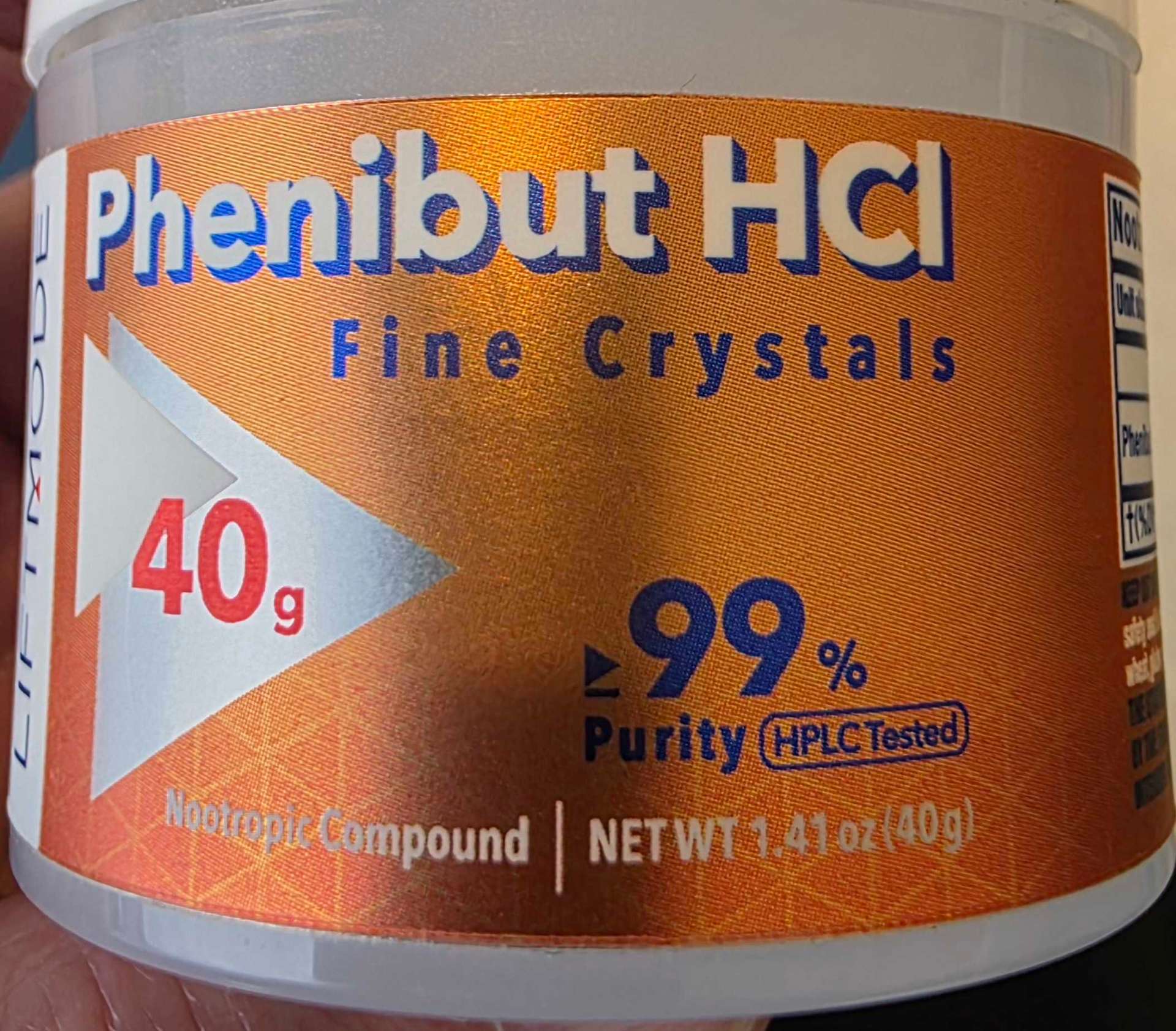
Licensing
This photograph may be reproduced by news organisations, free of charge, in coverage of phenibut, with the credit line Poison Phenibut. No permission request is necessary and none will be refused. It may not be used to advertise or endorse a product. A higher-resolution file is available on request.
Additional detail about this container is on the image details page.
4
Who runs this, and who pays for it
- What this is
- An independent educational project compiling primary-source information about the health risks of phenibut, so that the claims made about it can be checked.
- Who runs it
- A single volunteer operator. It is not a nonprofit, a trade body, a treatment provider, or an advocacy organisation with members.
- Funding
- None. The site has no revenue. It carries no advertising, no affiliate links, no sponsored content, and no vendor relationships. Nobody has paid for anything on it.
- Conflicts of interest
- None declared. The operator has no financial interest in phenibut, in any competing product, in any treatment provider, or in the outcome of any legislation.
- Affiliation
- None. Not affiliated with or endorsed by the CDC, FDA, DEA, SAMHSA, any government agency, or any healthcare provider.
- Clinical review
- None. No independent clinical reviewer has signed off on this content. If a board-certified medical toxicologist is willing to review it, we would like to hear from them.
5
Interview and correction requests
Interview requests, fact-checking queries, and corrections all go through the contact form in §8 of the dossier. Say that you are working on a deadline and it will be prioritised.
Corrections are the fastest route to our attention and are acted on rather than argued with. If a claim on this site is wrong, we will fix it and note that it was fixed.
6
References
- Graves JM, Dilley J, Kubsad S, Liebelt E. Notes from the Field: Phenibut Exposures Reported to Poison Centers — United States, 2009–2019. MMWR Morbidity and Mortality Weekly Report. 2020;69(35):1227–1228. doi:10.15585/mmwr.mm6935a5. cdc.gov/mmwr (PMID 32881852)
- FDA acts on dietary supplements containing DMHA and phenibut. U.S. Food and Drug Administration, Constituent Update. 2019. fda.gov
- Phenibut in Dietary Supplements. U.S. Food and Drug Administration. n.d.. fda.gov
- Lapin I. Phenibut (β-phenyl-GABA): a tranquilizer and nootropic drug. CNS Drug Reviews. 2001;7(4):471–481. doi:10.1111/j.1527-3458.2001.tb00211.x. PMID 11830761
- Owen DR, Wood DM, Archer JR, Dargan PI. Phenibut (4-amino-3-phenyl-butyric acid): availability, prevalence of use, desired effects and acute toxicity. Drug and Alcohol Review. 2016;35(5):591–596. doi:10.1111/dar.12356. PMID 26693960
- Phenibut: a recreational drug with abuse potential. National Capital Poison Center (Poison Control). n.d.. poison.org
- Esposito CM, Mandolini GM, Delvecchio G, Fiorentini A, Brambilla P. Psychomotor agitation non-responsive to treatment: a case report of phenibut withdrawal syndrome. Frontiers in Psychiatry. 2021;12:688147. doi:10.3389/fpsyt.2021.688147. PMID 34262493
- Joshi YB, Friend SF, Jimenez B, Steiger LR. Dissociative intoxication and prolonged withdrawal associated with phenibut: a case report. Journal of Clinical Psychopharmacology. 2017;37(4):478–480. doi:10.1097/JCP.0000000000000731. PMID 28614159
- Zheng KH, Khan A, Espiridion ED. Phenibut addiction in a patient with substance use disorder. Cureus. 2019;11(7):e5230. doi:10.7759/cureus.5230. PMID 31565631
- Nedzlek CD, Michaelis A. An unusual presentation of an uncommon drug: a case report on phenibut overdose. Cureus. 2022;14(4):e23913. doi:10.7759/cureus.23913. PMID 35530906
- Feldman R, Autry B, Dukes J, Lofy T, Marchetti G, Patt A, Batterman N, Theobald J. A systematic review of phenibut withdrawal focusing on complications, therapeutic approaches, and single substance versus polysubstance withdrawal. Clinical Toxicology. 2023;61(11):941–951. doi:10.1080/15563650.2023.2285702. PMID 38112312
- Bonnet U, Scherbaum N, Schaper A, Soyka M. Phenibut — an illegal food supplement with psychotropic effects and health risks. Deutsches Ärzteblatt International. 2024;121(7):222–227. doi:10.3238/arztebl.m2024.0003. PMID 38377332
- House Bill 2 (enrolled), amending Ala. Code § 20-2-25 to add phenibut to Schedule II. Alabama Legislature, 2021 Regular Session. 2021. Enrolled act (PDF)
- Fla. Stat. § 893.03, Standards and schedules. The Florida Senate, 2024 Florida Statutes. 2024. flsenate.gov
- Iowa Code ch. 124, Controlled Substances (schedules I–V). Iowa Legislature. 2025. legis.iowa.gov
Provenance
- Published
- Last reviewed
- Clinical review
- None. This content is compiled from the cited public sources and has not undergone independent clinical review.
Cite this page
Poison Phenibut. "Phenibut press kit." https://poisonphenibut.com/for-press (last reviewed September 8, 2026).
See About & editorial policy for how this site is written, reviewed, and corrected, and the disclaimer for what it is and is not.